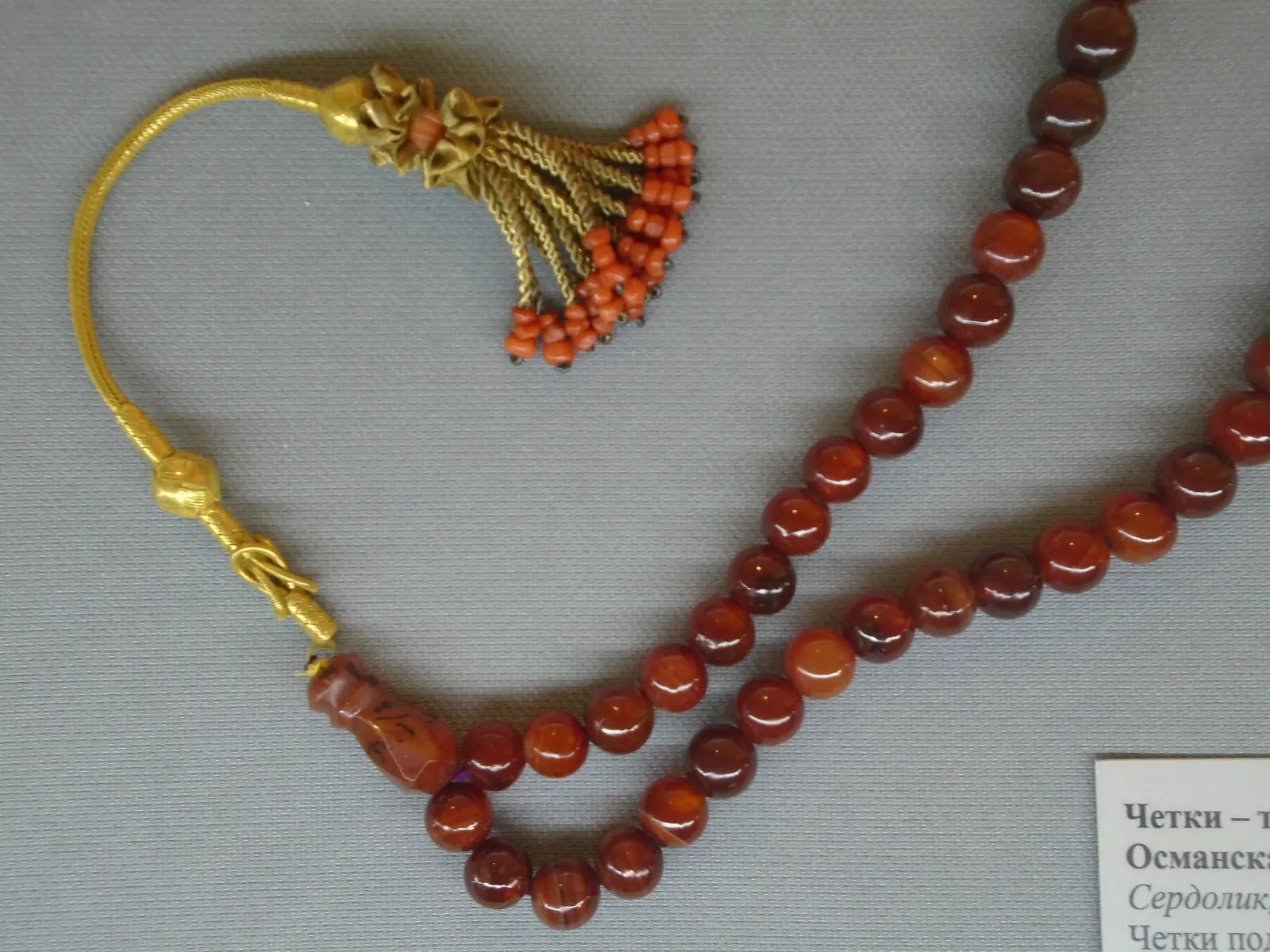
Samarkand’s sky: Ulugh Beg and the art of timing the dawn
Six hundred years ago a prince built an instrument the size of a hill to measure the sky. The Fajr time on your phone is its distant grandchild.
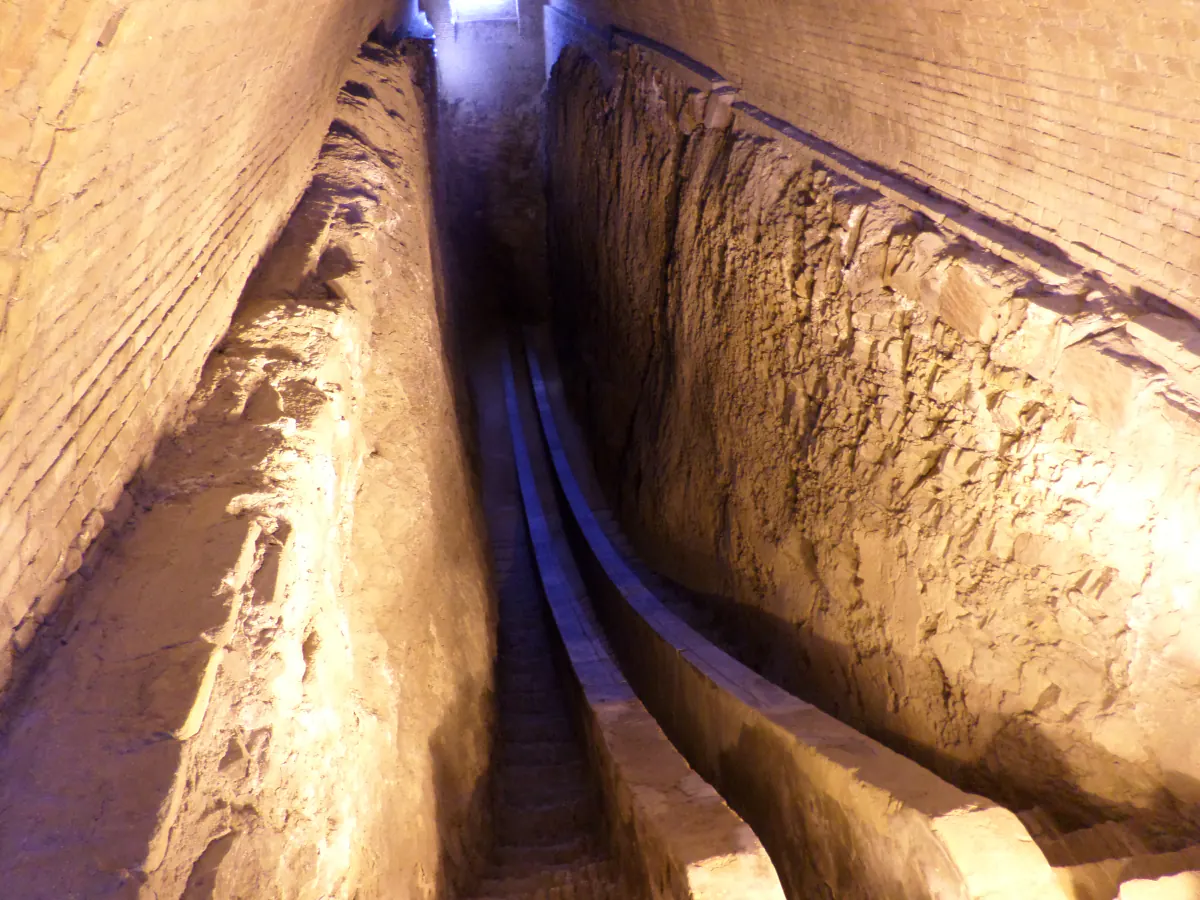
On Kohak hill, at the northern edge of Samarkand, a narrow stone trench cuts down into the earth. Walk to its mouth and you see two parallel rails, faced with polished stone, curving away into the dark like a frozen wave.
For more than four centuries nobody knew exactly where this was. In 1908 the archaeologist Vasily Vyatkin, guided by an old document that mentioned the site, dug here and found it: the lower part of what had once been the largest astronomical instrument in the world.
It was built to answer questions that sound abstract but are not. How long is a year? Where exactly is each star? And, for anyone who prays, the oldest question of all: when does the night end?
The prince who chose the stars
Muhammad Taraghay, known as Ulugh Beg, was born on 22 March 1394, a grandson of Amir Temur. While still a teenager, in 1409, he became governor of Samarkand, and he ruled the city for forty years.
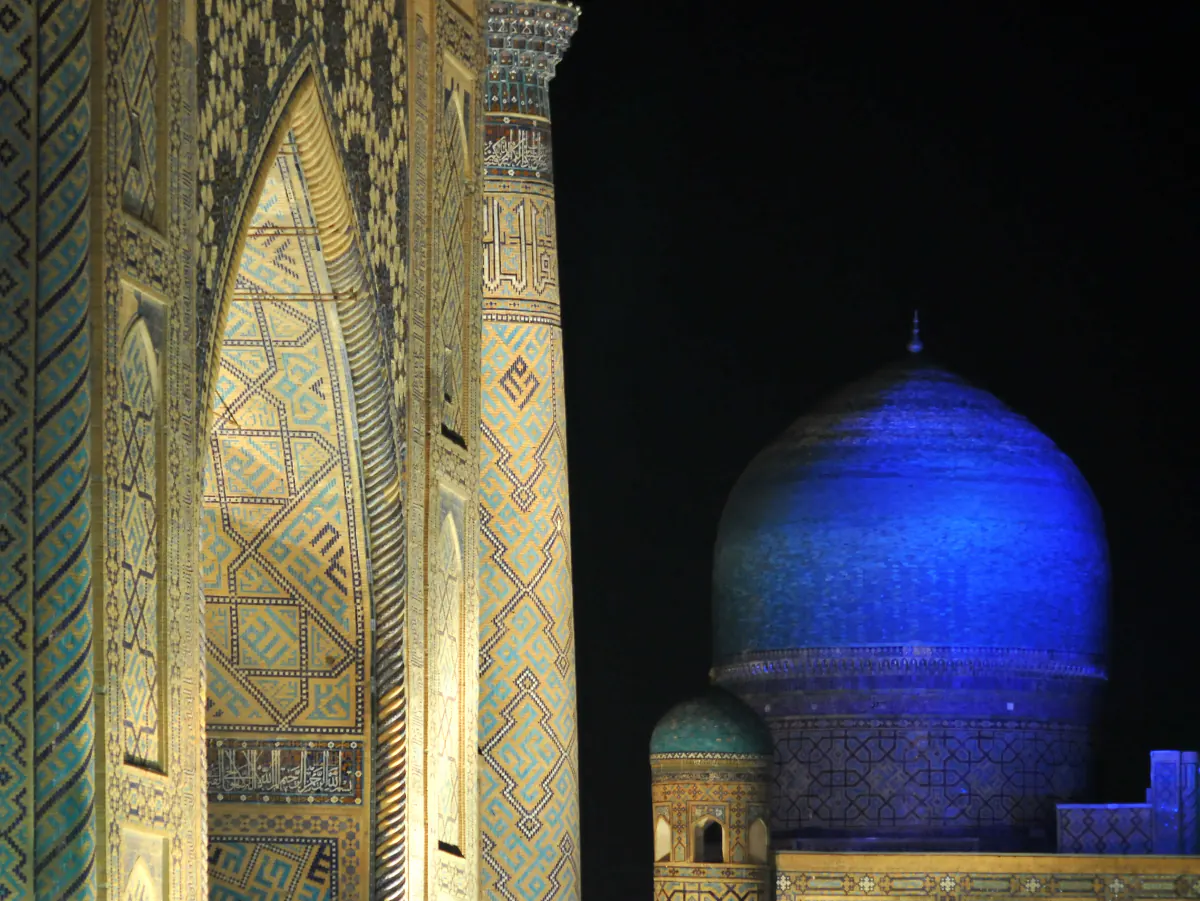
He was a ruler, but his real passion was mathematics and the sky. Between 1417 and 1420 he built a madrasa on the Registan where, next to the religious sciences, students learned astronomy and mathematics. It still stands, and its façade still carries the star patterns of its builders.
In the 1420s he began something bolder: an observatory on the hill outside the city, finished around 1428–1429. It was a round building about 46 metres across and some 30 metres high. To run it he gathered dozens of scholars, among them Jamshid al-Kashi, who in 1424 had calculated the number π to sixteen decimal places, and Qadizada al-Rumi, a mathematician who had come from Bursa. Later came Ali Qushji, his most famous student.
An instrument the size of a hill
The heart of the observatory was the Fakhri sextant: a huge arc laid exactly along the north–south line, with a radius of about 40 metres. Each degree on it was about 70 centimetres long. At noon a beam of sunlight fell through an opening in the roof onto the scale, and the astronomers read off how high the Sun stood.
Why so big? Because size is precision. On a small instrument a degree is a few millimetres and the eye cannot split it finely. On an arc forty metres long, the markings can be fine enough to read tiny fractions of a degree.
The results were collected in the Zij-i Sultani, completed in 1437. Among them:
- A catalogue of 1,018 stars: 992 positions measured anew in Samarkand, plus 27 southern stars taken from the older work of al-Sufi, because they never rise high enough to be seen from Samarkand.
- A length of the year of 365 days, 5 hours, 49 minutes and 15 seconds, within about half a minute of the modern value.
- The tilt of the Earth’s axis, 23°30′17″, very close to what it actually was in the fifteenth century.
- Tables of sines accurate to eight or more decimal places, the tools every later timekeeper needed.
In 2012 two astronomers, Frank Verbunt and Robert van Gent, compared the catalogue with the modern Hipparcos satellite data. Their verdict: it was the first large star catalogue since Ptolemy built on genuinely new, independent measurements.
The story has a sad ending. In October 1449 Ulugh Beg was killed on the orders of his own son, and the observatory was soon abandoned and taken apart. Ali Qushji carried the knowledge west, and in 1665 the star catalogue was printed in Oxford. The trench on Kohak hill kept its secret until Vyatkin’s spade.
Before the observatory: the timekeepers
The need for this precision is older than Ulugh Beg. Every one of the five prayers is set by the Sun: by the length of a shadow, by sunset, by the light of twilight. Muslim scholars called the science of these times ‘ilm al-miqat.
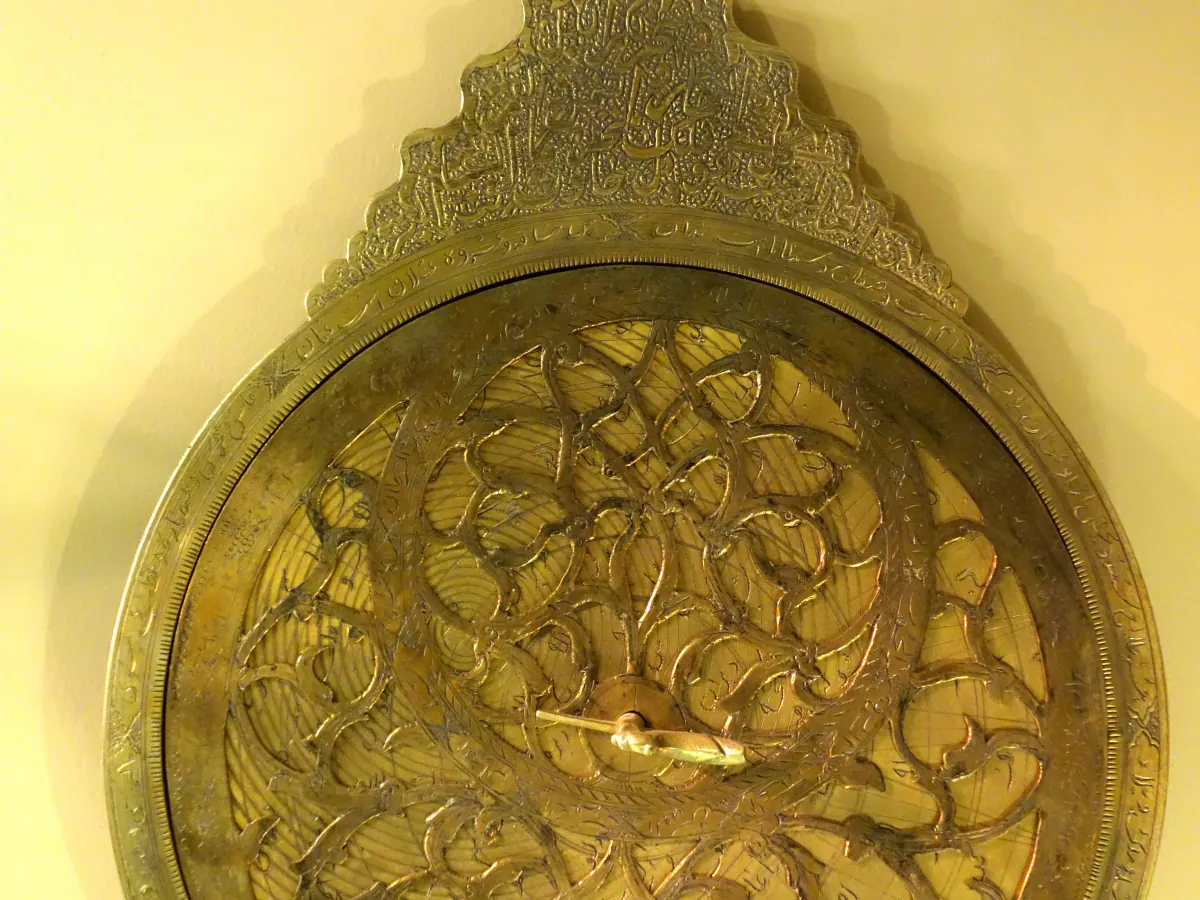
By the thirteenth century some large mosques had a professional astronomer on staff, the muwaqqit, or timekeeper. The earliest one known by name served in Fustat, in old Cairo, for thirty years and died in 1286 or 1287. Timekeepers used astrolabes, quadrants and sundials, and some of their tables held tens of thousands of entries.
Our own region had a giant in this field long before Samarkand’s observatory. Abu Rayhan al-Biruni was born in 973 in Kath, in Khwarazm, not far from today’s town of Beruniy in Karakalpakstan. In his great work al-Qanun al-Mas‘udi he described morning and evening twilight and concluded that it begins and ends when the Sun is about 18 degrees below the horizon.
ٱلشَّمْسُ وَٱلْقَمَرُ بِحُسْبَانٍ
The sun and the moon move by precise calculation. (translation of the meaning)
Qur’an 55:5
From the sextant to your phone
Here is the idea that connects Kohak hill to the phone in your pocket. Fajr is not really a clock time. It is a position of the Sun: the moment when the Sun, still hidden, reaches a certain angle below the eastern horizon. Astronomers call this the Sun’s depression angle.
Once scholars agree on the angle, the rest is the kind of arithmetic al-Kashi’s tables were made for: the Sun’s position for that date, your latitude and longitude, a little spherical trigonometry. The Muslim Board of Uzbekistan’s method uses 15.5° for both Fajr and Isha. Other bodies around the world use 18° or other values, because scholars and observers have reached different conclusions. That difference is honest, not a mistake.
On 24 September, for example, that calculation put Fajr in Tashkent at 04:53 and sunrise at 06:12, exactly as in the Muslim Board’s published timetable. Safa does the same sums on the phone itself, every day and without the internet. The sextant is gone; the question it was built for is asked again in millions of pockets before every dawn.
Pride, with the right size
It is worth being proud of this, and worth being accurate about it. Ulugh Beg did not invent astronomy. He and his colleagues inherited the work of Greek, Indian, Persian and Arab scholars, checked it against the sky, and improved it. That is what made them great: patience, measurement and the humility to correct old numbers.
Perhaps the best way to honour them is small. Tomorrow, when your alarm goes, step outside or to a window facing east for one minute before you pray. Look at the line where the sky is just starting to pale. Six centuries ago, people in Samarkand built a hill of stone to understand exactly that line.
Sources
- Verbunt & van Gent, 2012 — The star catalogues of Ptolemaios and Ulugh Beg, Astronomy & Astrophysics 544, A31
- Robert van Gent — Ulugh Beg and his contributions to late-Islamic astronomy (Utrecht University)
- Ulugh Beg Observatory — Wikipedia (dimensions, sextant, year length, Vyatkin 1908)
- MacTutor History of Mathematics — Ulugh Beg
- Muwaqqit — Wikipedia (the mosque timekeeper, earliest known in Fustat)
- David A. King — Astronomy in Medieval Jerusalem (Muslim Heritage)
- Atmanto — The concept of dawn and twilight in al-Biruni’s al-Qanun al-Mas‘udi, Analisa journal
- Praytime.uz — prayer times according to the Muslim Board of Uzbekistan’s timetable
- Qur’an 55:5 — quran.com
- Photos: cover — Adam Harangozó, Wikimedia Commons, CC BY-SA 4.0; Ulugh Beg Madrasa — LBM1948, Wikimedia Commons, CC BY-SA 4.0; sextant — Bobyrr, Wikimedia Commons, CC BY-SA 4.0; astrolabe — Daderot, Wikimedia Commons, CC0.
More to read