The tasbih: a short history of counting remembrance
From Fatima’s blistered hands to amber beads in a grandfather’s pocket: why Muslims count, and what counting does to attention.
After Bomdod, when the rows of the mosque have thinned out, there is usually one old man who stays behind. He sits against the wall with his legs folded, eyes half closed, and a string of beads moves slowly through his fingers. Click. Click. Click. Nobody else hears it. It is the quietest sound in the neighbourhood.
The tasbih is so familiar in Uzbek homes that we rarely ask where it came from. Why count remembrance at all? Why thirty-three? And why do some people insist on their fingers while others carry beads of amber or stone? The answers go back to a tired young woman, a millstone and a gift that was not what she asked for.
A gift better than a servant
Fatima, the daughter of the Prophet ﷺ, ground grain by hand every day, and her palms were blistered from the stone. When captives were brought to Madinah, she went to ask her father for a servant. He was not at home, so she told Aisha. That night the Prophet ﷺ came to the house of Ali and Fatima after they had already gone to bed.
“Shall I not tell you of something better than what you asked for? When you go to your beds, say Allahu Akbar thirty-four times, Alhamdulillah thirty-three times and SubhanAllah thirty-three times. That is better for you than what you asked for.” (translation of the meaning)
— Sahih al-Bukhari 3113; also Sahih Muslim 2727
The numbers add up to one hundred. In another narration in al-Bukhari (6318), the order is different, and a later narrator remarks that the thirty-four belongs to SubhanAllah. Scholars have treated both as acceptable. What stayed constant is the shape: three short phrases, a hundred in all, said at the end of a hard day.
There is also a counting after every prayer. Abu Hurairah narrated that whoever says SubhanAllah, Alhamdulillah and Allahu Akbar thirty-three times each after the prayer, and completes the hundred with La ilaha illallahu wahdahu la sharika lah, lahul-mulku wa lahul-hamd, wa huwa ‘ala kulli shay’in qadir, will have his sins forgiven even if they are like the foam of the sea (Sahih Muslim 597, translation of the meaning).
The first counter was a hand
Before anyone threaded a bead, the Companions counted on their fingers. Abdullah ibn Amr said he saw the Prophet ﷺ counting the tasbih on his hand (Jami‘ at-Tirmidhi 3486, graded sahih by Darussalam on sunnah.com). And Yusayrah, one of the women who migrated to Madinah, reported that the Prophet ﷺ told the women to count their remembrance on their fingertips, “for they will be questioned and made to speak” (Sunan Abi Dawud 1501, graded hasan by al-Albani; translation of the meaning).
That last phrase is striking. The fingers are not just a tool here; they are witnesses. On the Day of Judgement the hand that counted will speak for the person it belonged to. It is one reason many scholars say the fingers are the better way to count, even when beads are allowed.
Pebbles, date stones and a string
Some reports describe early Muslims counting on date stones or small pebbles. One of them, in Sunan Abi Dawud (1500), tells of a woman with a pile of date stones or pebbles in front of her. Hadith scholars such as al-Albani graded its chain as weak, so it is not something to build a ruling on. Still, the picture fits what we know of a desert town where dates were everywhere and nothing was wasted.
Strung beads spread through the Muslim world over the following centuries. Not everyone welcomed them. In the fifteenth century the Egyptian scholar Jalal ad-Din as-Suyuti wrote a short treatise, al-Minha fi’s-Subha, defending the use of beads against those who called them an innovation. Earlier, Ibn Taymiyyah had written that counting on the fingers is the Sunnah, and that counting with date stones, pebbles and the like is also good.
That is roughly where most scholars stand today: beads are permitted, the fingers are preferred by many, and a tasbih is a help, not an act of worship in itself. If you want a ruling for your own situation, ask the imam of your mosque. What matters far more than the tool is the heart behind the counting.
How a tasbih is made
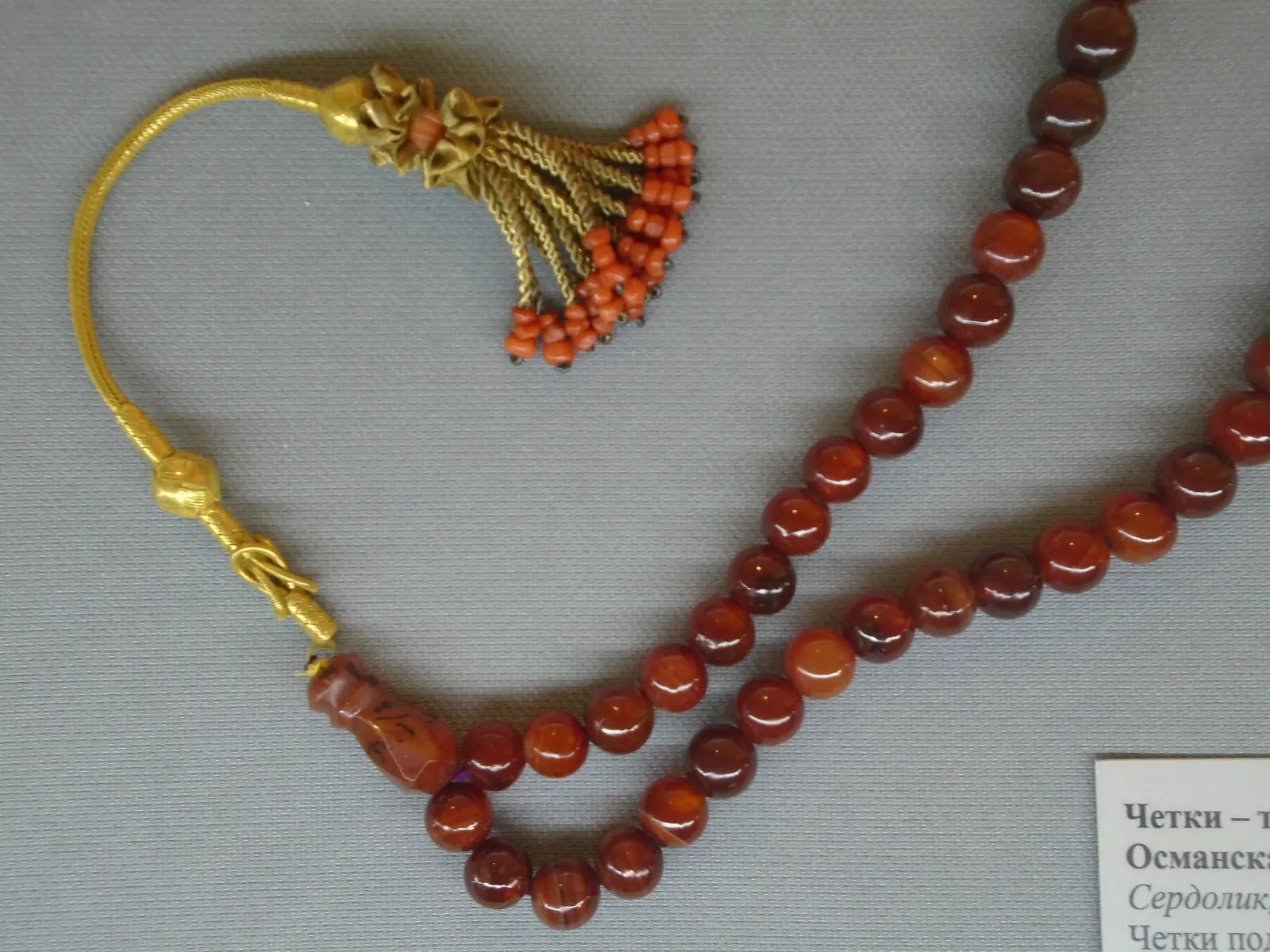
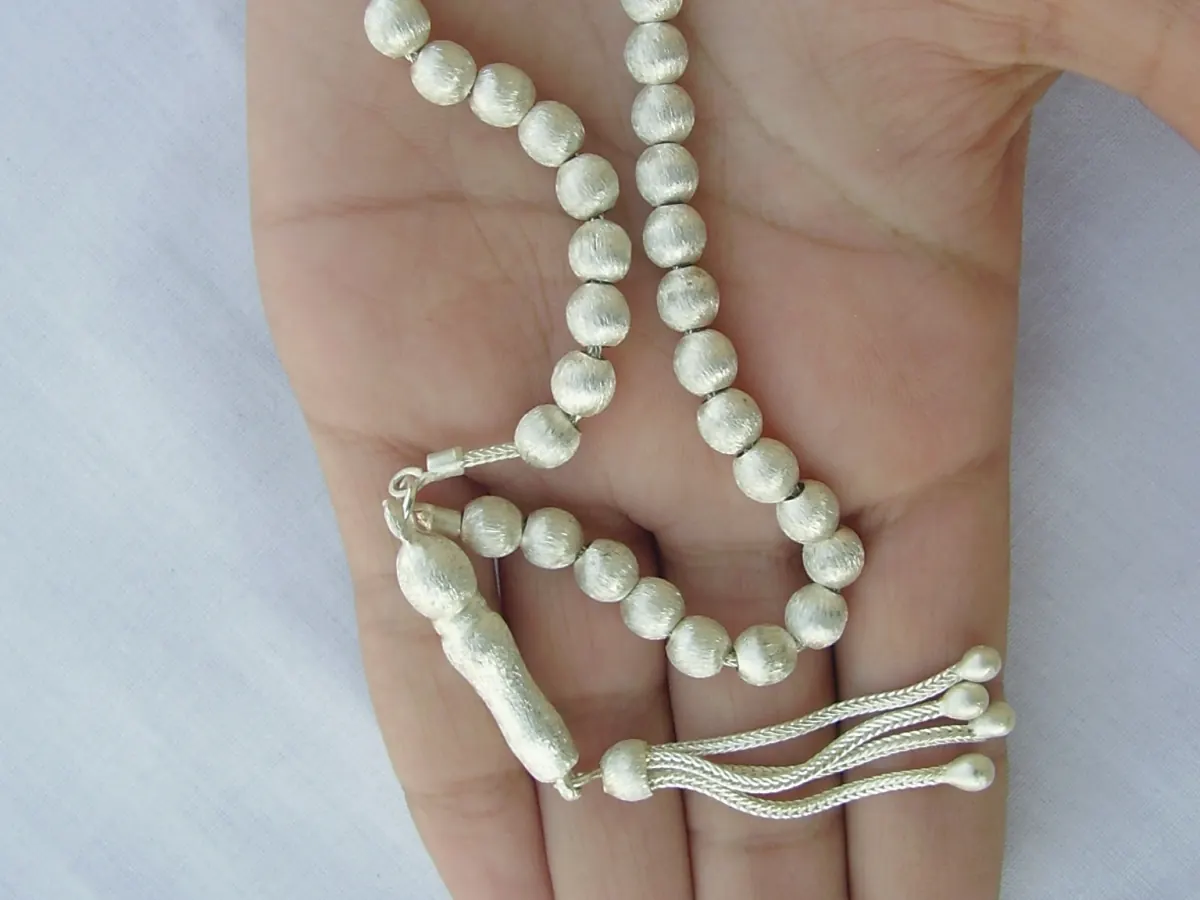
A classic tasbih has either thirty-three or ninety-nine beads. Larger separator beads divide the ninety-nine into three groups of thirty-three, so the thumb can feel where one phrase ends and the next begins without looking. At the end hangs a longer piece and a tassel, which marks the start and the finish.
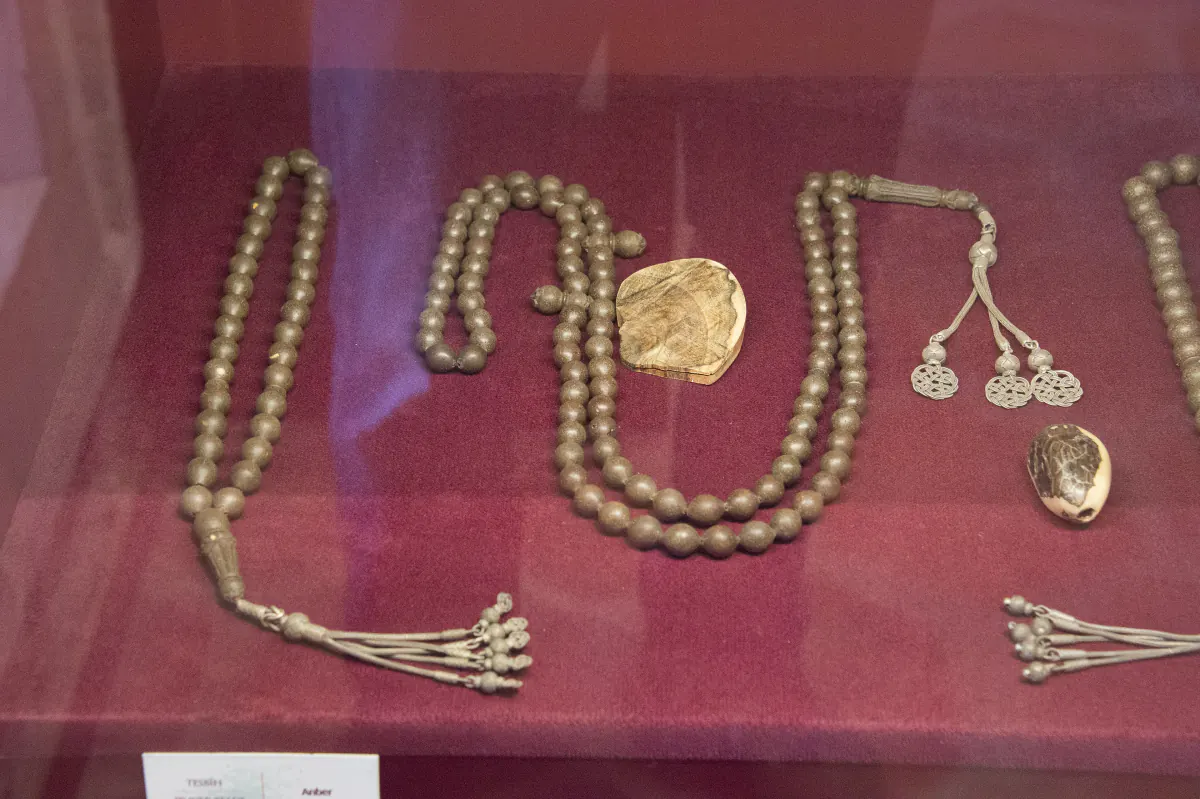
In Central Asia, as across the Muslim world, the materials tell a family story. Many homes keep a plain wooden tasbih for every day, a heavier one of stone or amber that belonged to a grandfather, and one brought back from Hajj or Umrah and given as a gift. Older pieces kept in museums are made of carnelian, agate, amber, bone and silver.
Why counting helps a wandering mind
In 2010 two Harvard psychologists, Matthew Killingsworth and Daniel Gilbert, used a phone app to ask thousands of people, at random moments, what they were doing and what they were thinking about. Their minds were somewhere else almost half the time, about 47 percent. And people were generally less happy when their minds wandered.
Anyone who has tried to say a hundred phrases of zikr knows this problem from the inside. By the twentieth SubhanAllah the mind is already planning lunch. Counting gives attention a small, concrete job. The beads or the finger joints hold the number, so you do not have to, and each new bead is a tiny reminder to come back.
Rhythm may matter too. In a small 2001 study in the BMJ, Luciano Bernardi and colleagues found that slowly repeating a fixed phrase, about six times a minute, drew 23 volunteers’ breathing into the same slow rhythm and strengthened natural rhythms of heart rate and blood pressure. It was a tiny study of other traditions’ prayers, so it proves little about zikr. But it hints at something many of us have felt: an unhurried count calms the body as well as the mind.
ٱلَّذِينَ ءَامَنُوا۟ وَتَطْمَئِنُّ قُلُوبُهُم بِذِكْرِ ٱللَّهِ ۗ أَلَا بِذِكْرِ ٱللَّهِ تَطْمَئِنُّ ٱلْقُلُوبُ
Those who believe and whose hearts find rest in the remembrance of Allah. Truly, in the remembrance of Allah hearts find rest. (translation of the meaning)
Qur’an 13:28
Beads, fingers or a screen
Today many people also count on a phone. Safa has a zikr counter drawn as a tasbih, where you can set a goal and see a quiet day-by-day record. It is simply another way of keeping the number, like a string of beads, and it cannot replace the fingers the hadith speaks of. Use whatever keeps your heart on the words.
The old man at the back of the mosque was not really counting beads. He was counting moments in which he remembered. The string in his hand was only there so that he would not have to think about the number, and could think about the One he was remembering instead.
Sources
- Sahih al-Bukhari 3113 and 6318 — sunnah.com
- Sahih Muslim 2727 — sunnah.com
- Sahih Muslim 597 — sunnah.com
- Jami‘ at-Tirmidhi 3486 — sunnah.com
- Sunan Abi Dawud 1501 and 1500 — sunnah.com
- Qur’an 13:28 — quran.com
- Ibn Taymiyyah on counting with beads, Majmu‘ al-Fatawa 22/506, quoted at IslamQA 3009
- Misbaha — Wikipedia (history of prayer beads, as-Suyuti)
- Killingsworth & Gilbert, 2010 — Science, “A wandering mind is an unhappy mind”
- Bernardi et al., 2001 — BMJ, rhythmic recitation and cardiovascular rhythms
- Photos: cover — Vyacheslav Kirillin, Wikimedia Commons, CC BY-SA 4.0; silver tasbih — Khalid Mahmood, Wikimedia Commons, CC BY-SA 3.0; museum beads — Dosseman, Wikimedia Commons, CC BY-SA 4.0
More to read


