
The science of gratitude, and why the morning is its hour
What twenty years of research really found about counting blessings, and a two-minute habit that fits right after Fajr.
The first words a Muslim is taught to say on waking are not a request. They are thanks. Before your feet find the floor, before you check the phone, the Sunnah puts one sentence in your mouth: praise be to Allah, who gave us life after He had caused us to die.
For a long time this could look like pure piety, far from anything a scientist would measure. Then, around twenty years ago, psychologists began to put gratitude in the laboratory. What they found is more modest than the self-help books claim, and more interesting.
Counting blessings in a lab
In 2003 Robert Emmons and Michael McCullough published a paper with a title that sounds almost like a sermon: “Counting blessings versus burdens”. In their first study, 192 university students kept a short weekly journal for ten weeks. One group wrote down five things they were grateful for. Another wrote down five hassles. A third simply listed five events of the week.
At the end, the gratitude group felt better about their lives as a whole and more hopeful about the coming week. They reported fewer physical complaints, and they said they had spent nearly an hour and a half more per week exercising than the group that wrote about hassles.
The honest part comes next. The same paper reported two more studies, and not everything repeated. In a shorter daily version, the effects on exercise and physical symptoms did not appear at all. The authors themselves wrote that not all findings replicated. The most reliable result across their studies was a rise in pleasant, positive feelings.
Three good things and a letter
Two years later, Martin Seligman and colleagues at the University of Pennsylvania tested several short exercises online. In one, called “three good things”, people wrote down each evening for a week three things that went well that day and why. In another, the “gratitude visit”, they wrote a letter of thanks to someone they had never properly thanked, and delivered it in person.
The letter gave the biggest immediate lift, which faded after about a month. The three good things started slowly but, in their data, people were happier and less depressed for up to six months. When Myriam Mongrain and her colleague Anselmo-Matthews repeated the study in 2012 with a better control group, happiness still rose. But it also rose in a comparison group that simply recalled positive memories, and the effect on depression was no bigger than in the controls.
One more finding is worth keeping. In 2018 Amit Kumar and Nicholas Epley asked people to write gratitude letters and then guess how the recipient would feel. The writers consistently underestimated how happy and surprised the recipients would be, and overestimated how awkward it would feel. The thank-you you keep putting off is probably worth more than you think.

How big is the effect, really?
When researchers pool many studies together, the picture becomes calmer. A 2016 meta-analysis led by Don Davis found that gratitude exercises had a modest effect on well-being compared with doing nothing, and almost no advantage over other active exercises such as simply describing your day. A 2021 meta-analysis by D. R. Cregg and Jennifer Cheavens, covering 27 studies and about 3,700 people, found a small effect on symptoms of depression and anxiety.
So gratitude is not a cure. If you are struggling with depression, a journal is not a replacement for a doctor. But a small effect from a practice that costs two minutes and nothing else, repeated every day for years, is not small in a life. And for a believer, the scientific effect was never the main reason.
Shukr: more than a feeling
وَإِذْ تَأَذَّنَ رَبُّكُمْ لَئِن شَكَرْتُمْ لَأَزِيدَنَّكُمْ ۖ وَلَئِن كَفَرْتُمْ إِنَّ عَذَابِى لَشَدِيدٌ
And when your Lord proclaimed: “If you are grateful, I will surely give you more; but if you are ungrateful, My punishment is severe indeed.” (translation of the meaning)
Qur’an 14:7
The psychologists measure gratitude mostly as a feeling. Classical Muslim scholars described shukr as something wider: acknowledging a blessing in the heart, praising the Giver with the tongue, and using the blessing in a way that pleases Him. Gratitude for good health, in this sense, is not only saying Alhamdulillah; it is also getting up and walking to prayer on the legs you were given.
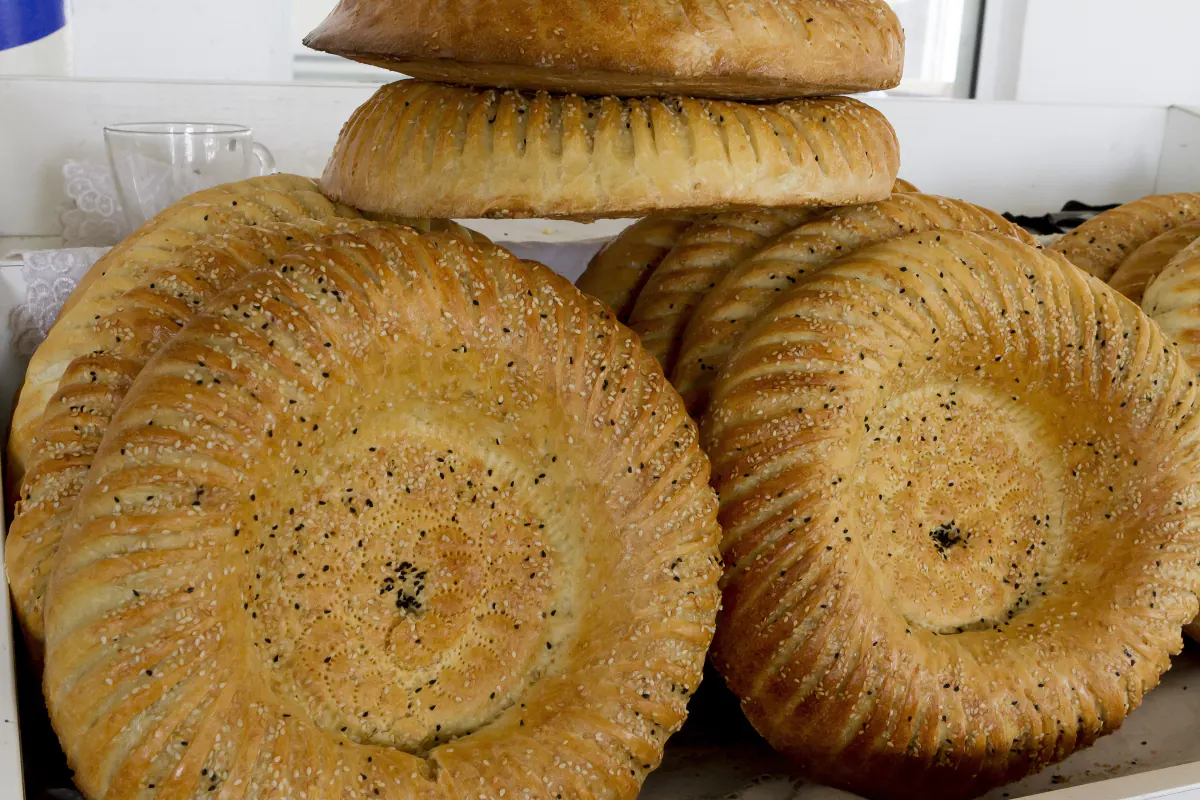
Uzbek homes already carry this idea in small habits. A piece of non dropped on the ground is picked up, touched to the forehead and placed somewhere high. Nobody explains it as a gratitude exercise, but that is exactly what it is: noticing a blessing and treating it with respect.
Why the morning is its hour
When the Prophet ﷺ woke up, he would say: “Al-hamdu lillahil-ladhi ahyana ba‘da ma amatana wa ilayhin-nushur.” Praise be to Allah, who gave us life after He caused us to die, and to Him is the return. (translation of the meaning)
— Sahih al-Bukhari 6312, narrated by Hudhayfah
There is no study proving that gratitude works better at dawn than at dusk. The reasons for the morning are simpler. The first blessing of the day is obvious and undeniable: you woke up. The mind has not yet filled with news and messages. And a habit sticks best when it is tied to something that already happens every day; for a person who prays, Fajr is exactly that kind of fixed point.

A two-minute habit after Fajr
- On waking: say the dua above before you reach for anything. Five seconds.
- After Fajr, stay seated: name three specific good things from yesterday. Not “my family”, but “my brother called to ask how I was”. Specific and new each day works better than the same general list.
- Add one “why”: for one of them, say why it happened or who made it possible.
- Close with *Alhamdulillah*, and mean the person, the bread, the breath.
- Once a week: turn one of the three into a message of thanks to the person involved.
Gratitude, in the end, is a way of looking. The morning gives us a clean page to practise it on, and the first line is already written for us: Alhamdulillah, we are alive again.
Sources
- Emmons & McCullough, 2003 — Journal of Personality and Social Psychology, “Counting blessings versus burdens”
- Seligman, Steen, Park & Peterson, 2005 — American Psychologist
- Mongrain & Anselmo-Matthews, 2012 — Journal of Clinical Psychology, a replication
- Kumar & Epley, 2018 — Psychological Science, “Undervaluing gratitude”
- Davis et al., 2016 — Journal of Counseling Psychology, meta-analysis of gratitude interventions
- Cregg & Cheavens, 2021 — Journal of Happiness Studies, gratitude and depression/anxiety
- Qur’an 14:7 — quran.com
- Sahih al-Bukhari 6312 — sunnah.com
- Photos: cover — Attokurov Nursultan (Аттокуров Нурсултан), Alatai lake at sunrise, Wikimedia Commons, CC BY-SA 4.0; letter — Aaron Burden, Wikimedia Commons (Unsplash), CC0; bread — Benjamin Goetzinger, Wikimedia Commons, CC BY-SA 4.0; sunrise — Noel Demulier, Wikimedia Commons, CC0
More to read


