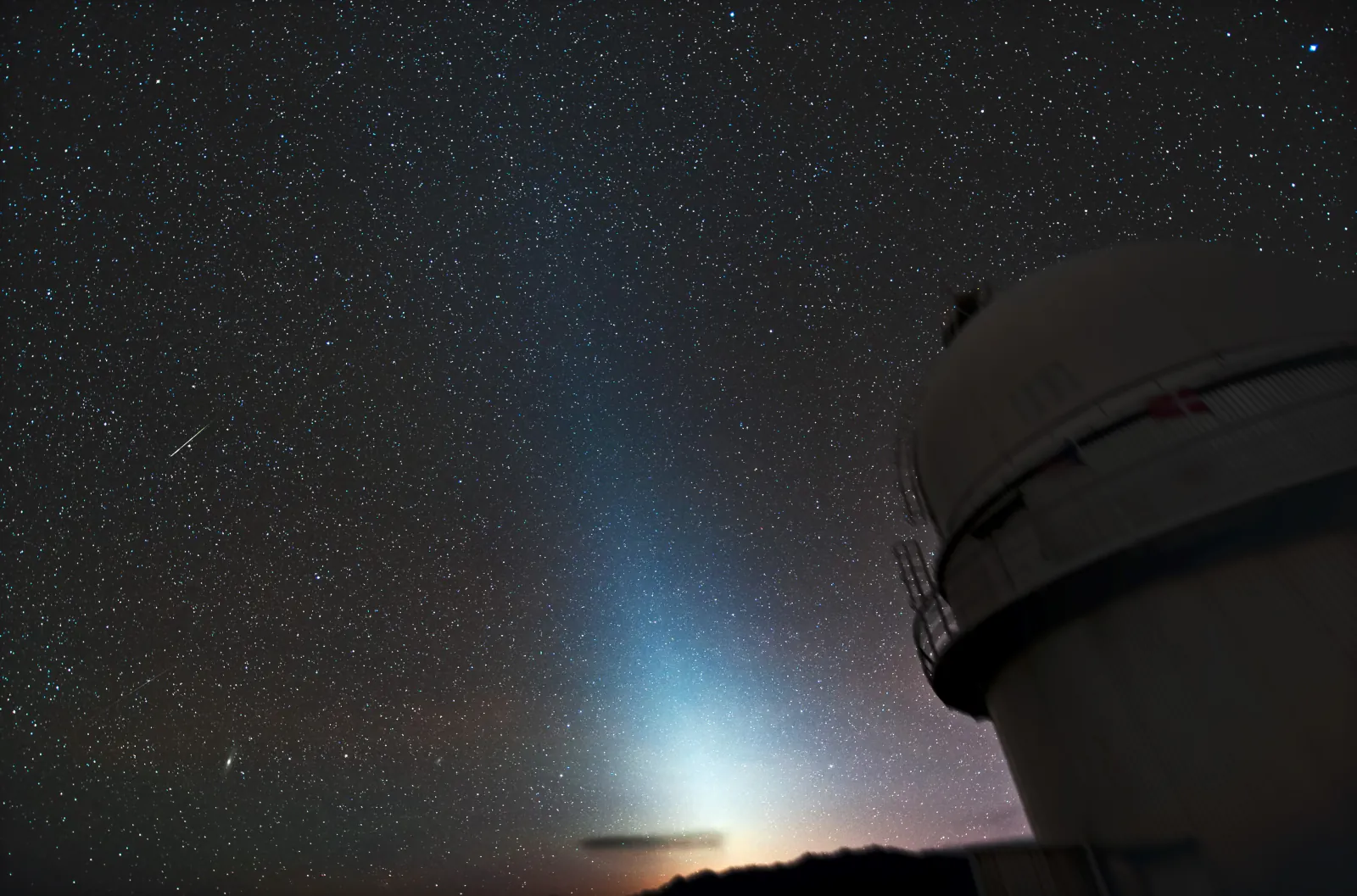
False dawn and true dawn: the light that lies
Before the real dawn, a pale column of light can rise in the east. What it is, why the Prophet ﷺ warned about it, and why most of us have never seen it.
One night in Madinah, a companion named Adi ibn Hatim put two cords under his pillow, one black and one white. A new verse had told the fasting to eat and drink until the white thread becomes distinct from the black. So he lay awake, checking his cords, waiting for the moment he could tell them apart.
In the morning he told the Prophet ﷺ. The answer, recorded by al-Bukhari, was gentle and a little amused: the threads are the darkness of the night and the whiteness of the dawn. In another narration he said that if both threads fit under Adi’s pillow, then it was a very wide pillow.
وَكُلُوا۟ وَٱشْرَبُوا۟ حَتَّىٰ يَتَبَيَّنَ لَكُمُ ٱلْخَيْطُ ٱلْأَبْيَضُ مِنَ ٱلْخَيْطِ ٱلْأَسْوَدِ مِنَ ٱلْفَجْرِ
And eat and drink until the white thread of dawn becomes distinct to you from the black thread [of night]. (translation of the meaning)
Qur’an 2:187
The verse describes something you can see: a line of light along the horizon. But the sky has another light that comes earlier, and it has misled people for as long as they have watched the east.
Two dawns
In Madinah there were two callers to prayer before Fajr. Bilal called while it was still night, so that those praying at night could finish and those asleep could wake. Ibn Umm Maktum called at dawn itself. The Prophet ﷺ told people to keep eating after Bilal’s call, until Ibn Umm Maktum’s.
Let neither Bilal’s call nor this whiteness, the pillar of the dawn, deceive you, until it spreads out like this. (translation of the meaning)
— Sahih Muslim 1094b, narrated by Samurah ibn Jundub
Another narrator of the same hadith showed with his hand what “like this” meant: stretched out sideways. In al-Bukhari’s collection, Abdullah ibn Mas‘ud recalls the Prophet ﷺ showing with his fingers the light that rises upward, which is not yet dawn; the narrators after him showed the real dawn by stretching two fingers out to the right and left.
Scholars named the two lights al-fajr al-kadhib, the false dawn, standing upright like a pillar, and al-fajr al-sadiq, the true dawn, lying flat along the horizon and spreading. Fajr prayer and the fast both begin with the second one. On this there is no disagreement.
What the false dawn really is
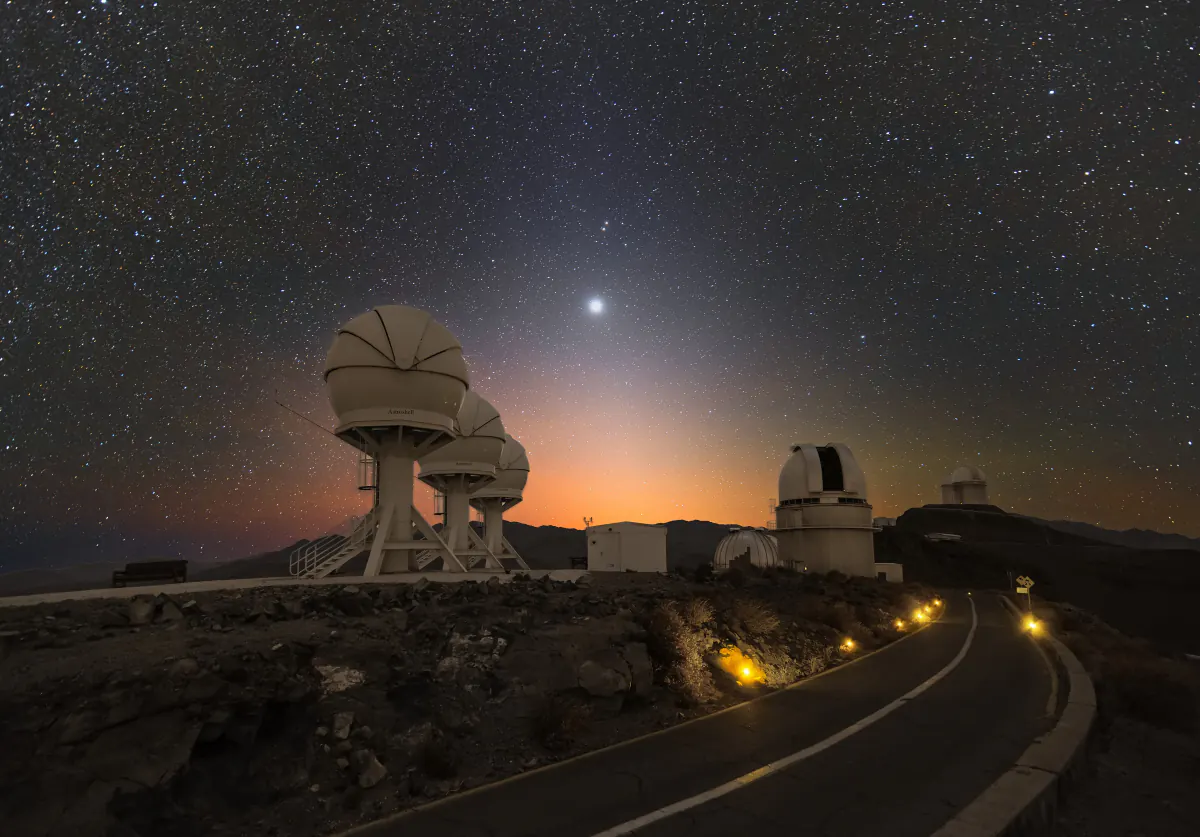
Astronomers know the pillar well. They call it the zodiacal light. The space between the planets is not empty: it holds a thin, flat cloud of dust, grains mostly between a hundredth and a third of a millimetre. Sunlight bounces off this dust, and on a very dark night we see it as a faint, tilted cone rising from the horizon.
The cone leans because the dust lies in the same flat plane as the planets’ orbits. Where the dust comes from is still being studied: most of it is thought to come from crumbling comets, and in 2021 data from NASA’s Juno spacecraft suggested that some of the dust near Earth may even come from Mars.
From our latitudes it shows best in the east on autumn mornings, before any twilight has begun, and in the west on spring evenings. It is as faint as the Milky Way, so moonlight or city light hides it completely. Then, as the real dawn grows, it is simply drowned.
The true dawn is a different thing entirely. It is sunlight scattered by the Earth’s own air, lighting the atmosphere just above the horizon from below. That is why it lies flat and spreads sideways, exactly the gesture in the hadith.
Three twilights, one question
Astronomers divide the time before sunrise by how far the Sun is below the horizon:
- Astronomical twilight, Sun 18° to 12° below: to the eye the sky still looks like night, but the faintest stars begin to fade.
- Nautical twilight, 12° to 6° below: the horizon becomes visible, which is what sailors needed to navigate.
- Civil twilight, 6° to 0°: bright enough to read outside without a lamp.
The first thread of true dawn appears somewhere around the first of these, and exactly where is the question. Al-Biruni, a thousand years ago in Khwarazm, put it at about 18°. Today’s methods range roughly from 12° to 20°: 18° for the Muslim World League, 19.5° in Egypt, 18.5° for Umm al-Qura in Makkah, 15° in North America, and 15.5° in the method of the Muslim Board of Uzbekistan.
Why so different? Partly because people went out and looked. Between 1984 and 1987, astronomers of Egypt’s national institute, NRIAG, watched for the first white light at four sites and found it on average at a depression of about 14.7°. Year-long observation projects in Britain, North America and Riyadh, summarised in 2024 by Mustafa Umar for the Fiqh Council of North America, reported values mostly between 12° and 18°. Humidity, dust, altitude, season and the observer’s eye all move the moment.
This is a genuine scholarly difference, reached in good faith. For daily practice, the sensible path is to follow the timetable of your own community, here the one published by the Muslim Board of Uzbekistan, and to take any particular question to a local scholar or the imam of your mosque rather than to an argument online.
The dawn most of us have never seen
Here is the uncomfortable part. In 2016 Fabio Falchi and colleagues published a world atlas of night-sky brightness. More than 80% of the world’s people, they found, live under light-polluted skies, and the Milky Way is hidden from more than a third of humanity. In 2023, Christopher Kyba’s team, using reports from citizen observers, found the night sky growing brighter by nearly 10% a year.
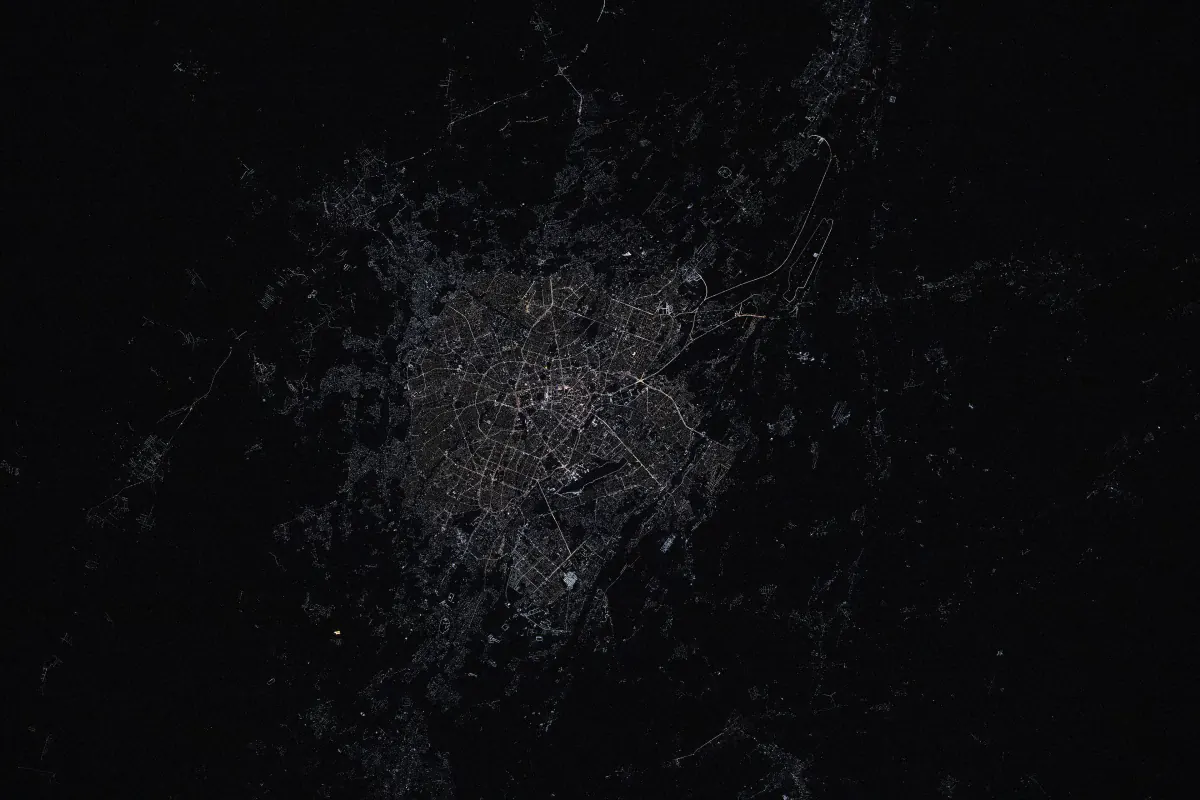
In a city like Tashkent, the zodiacal light is simply gone, and even the first whiteness of the true dawn is washed out by street lamps. Our grandparents in the villages knew both lights by sight. We know them from a timetable. Calculation is a trusted tool, and scholars accept it, but something was lost when the sky stopped being the clock.
And if a trip to the desert is not possible this year, start smaller. Tomorrow, before you pray Fajr, switch off the room light and look east through a window for one minute. You may not see a thread. But you will have looked where the verse asks us to look, and that is where the habit of noticing begins.
Sources
- Qur’an 2:187 — quran.com
- Sahih al-Bukhari 1916 (Adi ibn Hatim and the two threads) — sunnah.com
- Sahih al-Bukhari 4509 (the wide pillow) — sunnah.com
- Sahih al-Bukhari 1918 (Bilal and Ibn Umm Maktum) — sunnah.com
- Sahih al-Bukhari 621 (the gesture of the two dawns) — sunnah.com
- Sahih Muslim 1094b — sunnah.com
- Zodiacal light — Wikipedia
- Jorgensen et al., 2021 — Distribution of interplanetary dust detected by the Juno spacecraft, JGR Planets
- Twilight: civil, nautical and astronomical — Wikipedia
- PrayTimes.org — calculation methods and their Fajr angles
- Hassan et al., 2014 — Naked eye observations for morning twilight at different sites in Egypt, NRIAG Journal of Astronomy and Geophysics 3(1)
- Mustafa Umar, 2024 — Fifteen or Eighteen Degrees: Calculating Prayer & Fasting Times in Islam, Fiqh Council of North America
- Falchi et al., 2016 — The new world atlas of artificial night sky brightness, Science Advances
- Kyba et al., 2023 — Citizen scientists report global rapid reductions in the visibility of stars from 2011 to 2022, Science
- Photos: cover — Zdeněk Bardon (bardon.cz)/ESO, Wikimedia Commons, CC BY 4.0; zodiacal light and Venus over La Silla — Zdeněk Bardon (bardon.cz)/ESO, Wikimedia Commons, CC BY 4.0; Tashkent from the ISS — NASA Johnson Space Center, Wikimedia Commons, public domain.
More to read


