
When you sleep through Fajr
A missed morning is not a verdict on who you are. What the Sunnah teaches, what psychology adds, and what to do next.
The room is already bright. Before your eyes are fully open, you know what the light means: the sun is up, and Fajr passed while you slept. The first feeling is a hot wave of shame.
The second thought is usually worse: I’m just not someone who can do this. That thought does the real damage, and it is not true. One morning tells you something about last night — how late you slept, where the phone was, how tired you were. It says nothing final about who you are.
It happened to the best of people
On a journey, the Prophet (peace be upon him) and his companions stopped to rest in the last part of the night. Bilal promised to stay awake and wake everyone for the prayer. He leaned back against his camel’s saddle — and sleep overtook him too. They woke only when the edge of the sun had already risen.
There is no anger in what happened next. The Prophet (peace be upon him) calmly explained what had taken place, waited until the sun had risen fully and grown bright, and then led them in prayer.
Allah took your souls when He willed, and returned them when He willed.
— Sahih al-Bukhari 595 (translation of the meaning)
In a longer account of a similar journey, recorded in Sahih Muslim (681), he told the companions that there is no negligence in sleep; negligence belongs to the one who, awake, lets a prayer go until the time of the next one comes. Sleep is not a sin. The choice begins after we open our eyes.
First, the prayer
So the first step is simple, and it is an action rather than a feeling: make up the prayer. In Islamic law this is called qada, and the Prophet (peace be upon him) gave a clear rule for it.
Whoever forgets a prayer or sleeps through it, its expiation is that he prays it when he remembers it.
— Sahih Muslim 684; see also Sahih al-Bukhari 597 (translation of the meaning)
Notice what the hadith does not say. It does not ask you to punish yourself, and it adds no penalty on top. The expiation is the prayer itself — done as soon as you can.
One practical detail. In the Hanafi school, which most people in Uzbekistan follow, no prayer is performed while the sun is actually rising. If you wake right at sunrise, wait until the sun is fully up — often counted as about 15–20 minutes — and then pray. The story above shows the same patience. If you are unsure about your situation, ask the imam of your mosque.
Why shame is poor fuel
It can feel as if being hard on yourself is what keeps you serious. Research suggests the opposite. The psychologist Kristin Neff of the University of Texas, who brought the idea of self-compassion into research psychology in 2003, describes it as treating yourself after a failure the way you would treat a good friend. It has three parts:
- Kindness instead of harsh judgment: “That was a hard morning,” rather than “I am hopeless.”
- Common humanity: remembering that everyone who has tried to wake for Fajr has overslept at some point — even the companions.
- Mindfulness: noticing the disappointment honestly, without letting it grow into a story about your whole life.
This is not letting yourself off the hook. In 2012, Juliana Breines and Serena Chen at the University of California, Berkeley, published four experiments. In one, students who failed a difficult vocabulary test and were then encouraged to be kind to themselves studied longer for a second try than students whose self-esteem was simply boosted. In another, people who recalled a past wrongdoing with self-compassion were more motivated to make amends and not repeat it.
A smaller study points the same way. Michael Wohl and colleagues at Carleton University in Canada followed 119 first-year students across two exams. Those who forgave themselves for putting off study before the first exam procrastinated less before the second. Shame pushes us away from whatever caused it. Forgiveness lets us come back.
Then, find the cause
“I am lazy” is a conclusion with no next step. A specific cause always points to a specific fix. Once you have prayed, ask yourself four quiet questions:
- When did I go to bed? If I slept less than six hours, the cause is already found.
- Did the alarm ring at all? Was the phone on silent, out of charge, or in another room?
- Did I switch it off and not remember? This is the most common case of all.
- Did I get up and then lie down “for a minute”? Then the problem is not the alarm but the two minutes after it.
What Safa does on such a morning
If Fajr passes without the alarm’s mission being done, Safa does not flash red or scold. It shows a quiet screen: the risen sun, a consoling word, and the time of tomorrow’s Fajr, so the next step is already in front of you. There is no donation request on that screen. Nothing can be bought there, and money never buys back a streak.
The streak stays honest: a missed morning ends it, and your longest streak remains on record. If you know in advance that a morning will be different — a journey, an illness — you can skip it beforehand, up to two mornings in any seven days. And if you wake before the alarm, the “I’m awake” button in the 15-minute heads-up lets you do the mission early, so the morning counts.
إِنَّ مَعَ ٱلْعُسْرِ يُسْرًا
Indeed, with hardship comes ease. (translation of the meaning)
Qur’an 94:6

Tonight
The whole plan fits into one evening. Pray what you missed, without drama. Answer the four questions honestly. Choose a bedtime that leaves room for enough sleep: an expert panel of the American Academy of Sleep Medicine recommends at least seven hours a night for adults. Check that the phone is charged and the volume is up.
Then say to yourself the sentence you would say to a friend: It was one morning. Tomorrow is another. The companions woke to a risen sun, prayed, and carried on. So can you.
Sources
- Sahih al-Bukhari 595 — sunnah.com
- Sahih al-Bukhari 597 — sunnah.com
- Sahih Muslim 681 — sunnah.com
- Sahih Muslim 684 — sunnah.com
- Qur’an 94:5–6 — quran.com
- Neff, 2003 — Self and Identity
- Breines & Chen, 2012 — Personality and Social Psychology Bulletin
- Wohl, Pychyl & Bennett, 2010 — Personality and Individual Differences
- Watson et al., 2015 — Sleep (recommended amount of sleep for adults)
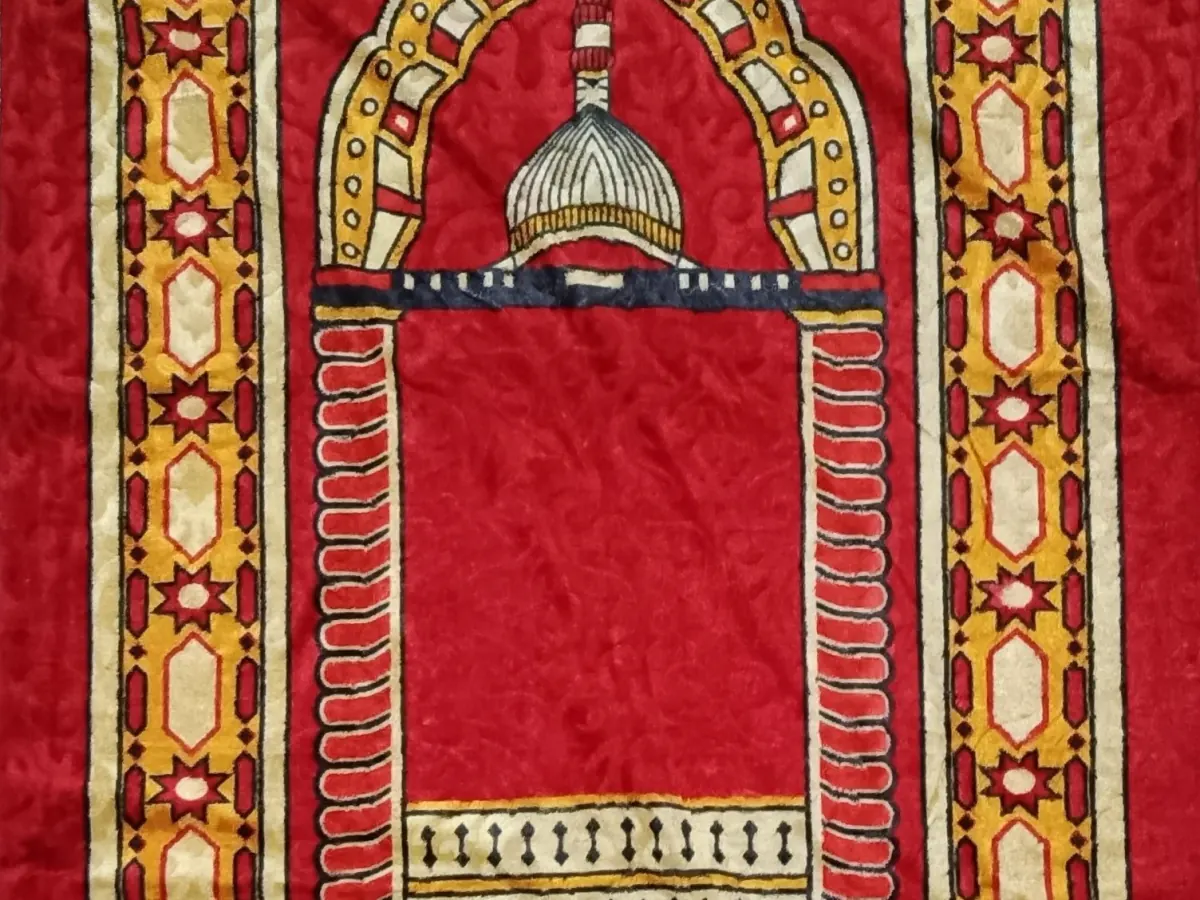
- Photos: cover — Registan square after sunrise, Samarkand, Ekrem Canli, Wikimedia Commons, CC BY-SA 3.0; prayer mat — Mian09, Wikimedia Commons, CC0; Ugam-Chatkal mountains from Kokbet — Givte, Wikimedia Commons, CC BY-SA 4.0.
More to read


